Abandoned carts are a normal part of selling online. People add items while comparing prices, get interrupted by a call, or wait for payday. Baymard Institute’s cart abandonment research, which averages 50 studies, puts the average documented abandonment rate at 70.22%. In other words, roughly seven in ten carts are left behind.
Email reminders have been the standard response for years. For many Indian and Gulf shoppers, though, WhatsApp is where they actually read messages, so a cart reminder there is more likely to be seen. That also makes it easier to annoy people, because a chat app feels personal.
This guide covers what to send, when to send it, whether to offer a discount, and how to measure what you really recover, without turning a helpful reminder into spam.
Check the rules before you build the flow
Two rules shape everything else.
First, cart reminders count as marketing. Meta’s template guidelines list “You left items in your cart” as an example of a retargeting message. They also state that such messages are marketing even if requested by users. You will need an approved marketing template, and each reminder is charged as a marketing message.
Second, you need the customer’s permission to receive marketing messages from you on WhatsApp. The cleanest place to get it is at checkout, with a clear unticked checkbox beside the phone number field, such as “Send me order updates and offers on WhatsApp”. Our guide to building a WhatsApp opt-in list the right way covers the wording and how to record consent. Only customers who tick it should enter the cart recovery flow.
If you skip these rules, the flow may look successful for a few weeks before block and report rates catch up with you.
Decide who enters the flow
Not every abandoned cart deserves a message. Before the first reminder goes out, filter out:
- People who already bought. Check for a completed order from the same number or email, including orders placed through a different device.
- COD orders already confirmed. A customer who switched to cash on delivery has not abandoned anything.
- Very low-value carts where the message cost and effort outweigh the likely margin.
- Anyone who opted out of offers, even if they still receive order updates.
- Repeat abandoners in a short window. If someone abandoned three carts this week, one reminder is enough.
This step alone removes much of the irritation that gives cart recovery a bad name.
A simple three-message sequence
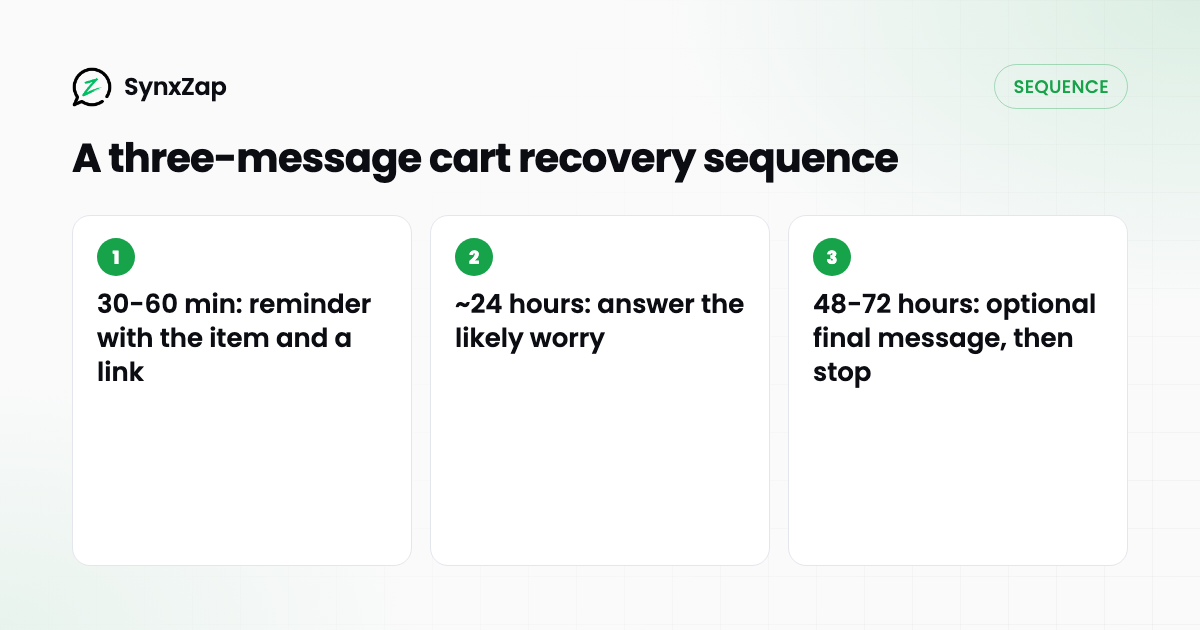
Timing should be tested for your own store, but a sensible starting sequence looks like this. The intervals below are a starting point to test, not benchmarks.
Message 1: a gentle reminder (around 30-60 minutes after abandonment)
Show what they left, with a product image, the item name and a link straight back to the filled cart. Add an offer of help, because many abandonments come from a question rather than a lack of interest.
Hi Priya, you left the linen kurta (size M) in your cart. It’s saved for you here: [link]. If you have a question about sizing or delivery, just reply to this message.
Message 2: answer the likely objection (around 20-24 hours later)
If there is no purchase and no reply, send one message that removes a common worry for your category. For fashion this might be returns and sizing. For electronics, warranty. For furniture, delivery and installation. This is more persuasive than repeating “complete your purchase”.
Message 3: optional, final and clear (around 48-72 hours later)
Use a third message only if your data shows it earns its keep. It can include a small incentive (see below) or simply let the customer know the cart will be cleared. After this, stop. Do not move the customer into a daily promotional loop because they once left a cart.
What makes a recovery message work
| Do | Avoid |
|---|---|
| Use the customer’s name and the actual product | Generic “You forgot something!” |
| Link back to the filled cart, not the homepage | Making them search for the product again |
| Invite replies and answer them quickly | No-reply messages that ignore questions |
| Mention delivery time, returns or COD where relevant | Pressure tactics and fake countdowns |
| Keep it to two or three short lines | Long paragraphs with several offers |
The reply option deserves special attention. A chat reminder that a person, or an AI assistant trained on your policies, can answer within minutes often recovers sales that a one-way message never would. Someone asking “will this reach Kochi by Saturday?” is very close to buying.
Templates need Meta’s approval before you can use them, so write them carefully and keep a few tested versions ready. A library of approved message templates is a useful starting point.
Should you offer a discount?
A discount can tip a hesitant buyer, but it has costs that are easy to miss:
- It trains customers to abandon. If every cart reminder comes with 10% off, regular buyers learn to wait for it.
- It cuts margin on orders that would have happened anyway. Some customers were always going to come back.
- It changes the conversation from “is this right for me?” to “how cheap can I get it?”
Better options are usually help, reassurance, or a non-price benefit: free shipping above a threshold, a gift-wrap option, or a small benefit for paying online instead of COD. If you do use discounts, limit them to the final message, to first-time buyers, or to higher-value carts, and use a single-use code so it cannot circulate.
The COD angle for Indian D2C brands
For many Indian D2C brands, the payment step is a common sticking point. Customers may hesitate to pay upfront to an unfamiliar brand, or the store may not offer COD for that pincode.
Cart recovery on WhatsApp is a good moment to address this directly. Confirm whether COD is available for their location, explain your returns process in a line, or offer a small benefit for prepaid. Our COD to prepaid playbook goes deeper on nudging customers towards online payment without losing the sale.
Measure recovered revenue honestly
“Revenue from cart recovery” dashboards often overstate results, because they count every order that followed a message, including ones that would have happened anyway. Track a few clearer figures:
- Recovery rate: orders from messaged carts divided by carts messaged.
- Net recovered revenue: revenue from those orders, minus discounts given and message costs.
- Opt-out and block rate for the flow. A rising rate is an early warning.
- Reply rate, which shows whether people find the messages useful.
For a fair picture, hold back a small random group of eligible carts that receive no message. The difference in purchase rate between that group and the messaged group shows how much the flow actually adds.
Common questions
How many cart reminders should we send on WhatsApp?
Two is enough for most stores, and three should be the maximum. Stop immediately once the customer buys, replies to say no, or opts out.
Can we send cart reminders to customers who haven’t opted in?
No. Meta treats cart reminders as marketing, so you need the customer’s opt-in to receive messages from your business. Collect it at checkout so the flow has people to work with.
Is WhatsApp better than email for cart recovery?
It depends on your customers. In markets where WhatsApp is the main way people communicate, reminders there are more likely to be seen. Many stores use both: WhatsApp for customers who opted in, and email as a fallback.
Start small and stop at the right time
Set up the first two messages, filter out people who should not receive them, and measure against a holdout group for a few weeks before adding incentives. The same principle applies to any automated follow-up: clear stop rules keep it helpful. AI with Akshay’s guide to building a follow-up system around ownership and next actions covers that thinking in more detail.
To connect your store, switch on cart recovery and handle replies in one shared inbox, see how SynxZap works for D2C and retail brands.